
20 Seconds, 26.8K Temperature Drop: A New Cooling Paradigm for the AI Era

Cooling technology supports 25%–30% of global electricity consumption, from residential air conditioning and refrigeration to industrial processes and hyperscale data centers.
For more than a century, vapor-compression refrigeration has dominated the industry. While mature and highly optimized, these systems rely on fluorocarbon refrigerants with high global warming potential and are approaching their thermodynamic efficiency limits.
At the same time, AI computing is rapidly increasing heat density across servers, power electronics, and HVAC infrastructure. Thermal management is no longer just a support function — it is becoming a critical performance constraint.
A recent breakthrough published in Nature introduces a new direction for sustainable, high-efficiency cooling.
26.8K Cooling in 20 Seconds: Dissolution-Driven Barocaloric Effect
Researchers from the Chinese Academy of Sciences and collaborating institutions reported an extreme barocaloric effect in ammonium thiocyanate (NH₄SCN) aqueous solutions, enabled by pressure-tuned dissolution and precipitation.
The mechanism works as follows:
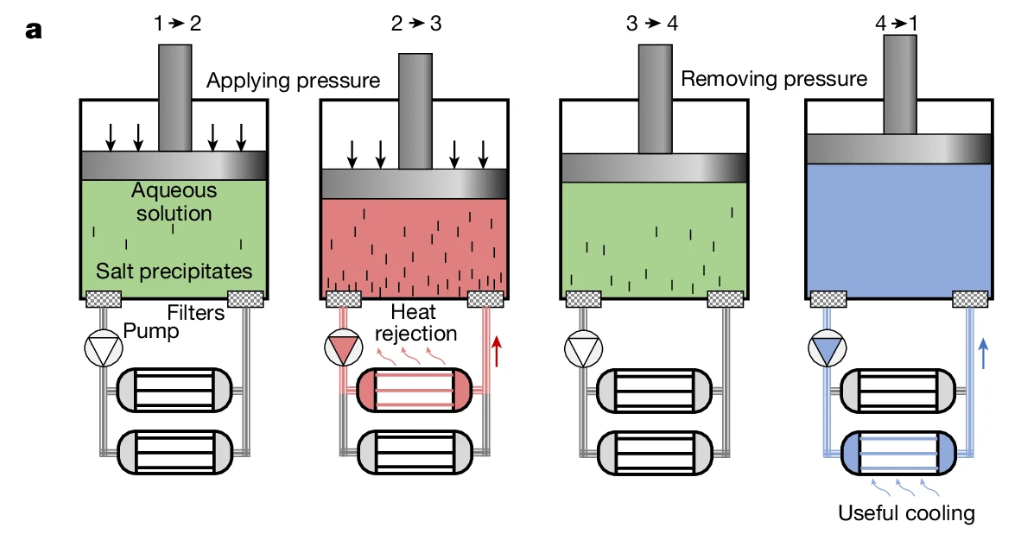
- Under increased pressure, the salt precipitates and releases heat
- Upon pressure release, the salt dissolves rapidly and absorbs heat
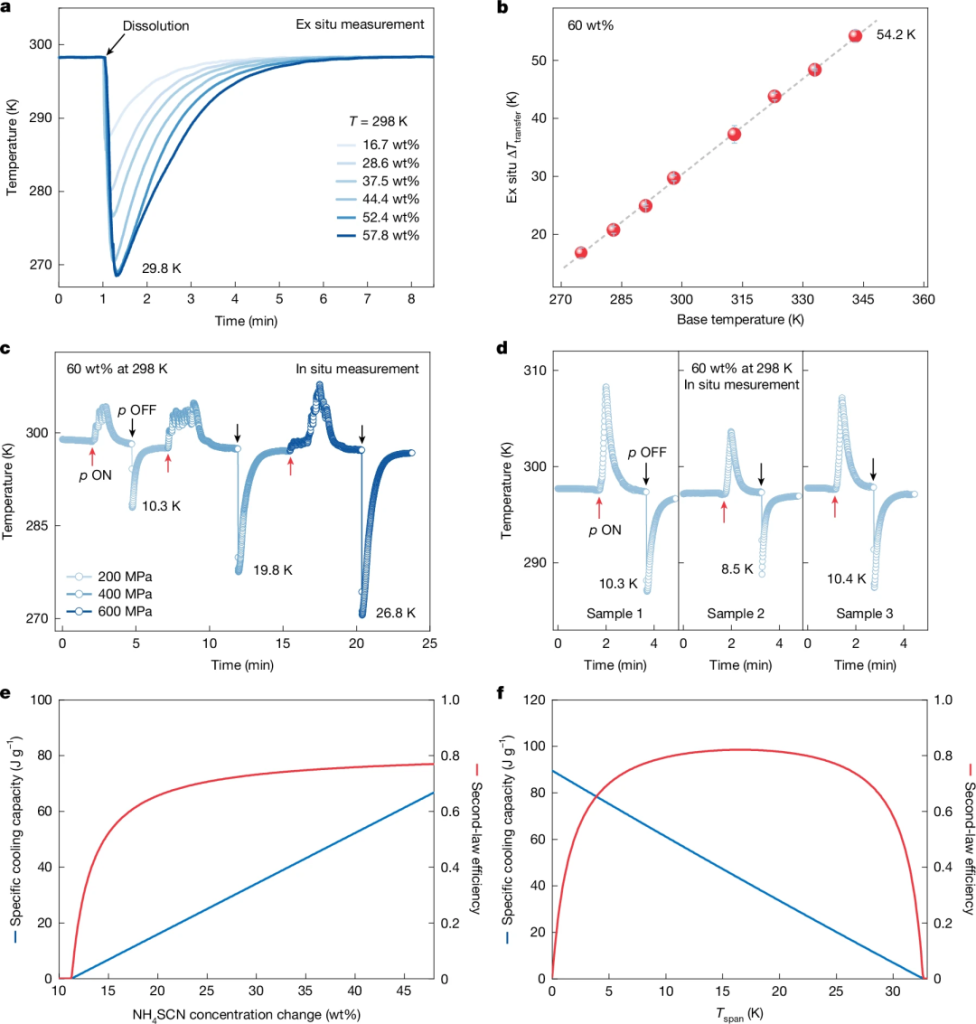
- An in situ temperature drop of 26.8K at room temperature was achieved
- Cooling occurs within approximately 20 seconds
- A Carnot-like cycle delivers 67 J/g cooling capacity per cycle
- The measured second-law efficiency reaches 77%
For comparison:
- Conventional vapor-compression refrigeration: 30%–50%
- Existing solid-state barocaloric systems: 50%–60%
This reported performance surpasses all known caloric materials in terms of in situ temperature drop.
Even more notably, at elevated ambient temperatures of 60–70°C, the system can generate temperature drops of up to 50°C — a characteristic highly relevant for high-heat-flux applications.
Unlike traditional solid-state caloric refrigeration, which suffers from indirect heat transfer through secondary fluids, this solution-based system enables direct heat transfer through the self-circulating aqueous medium, significantly improving practical cooling efficiency.
Why This Matters: AI and High-Power Systems Are Redefining Cooling
By 2027, a single high-end GPU is projected to exceed 2 kW of heat generation, concentrated within an extremely compact footprint.
In high-density AI data centers:
- Cooling capacity directly limits computing scalability
- Energy efficiency determines operational cost
- Thermal stability defines system reliability
Emerging cooling mechanisms — including pressure-driven solution systems — may soon complement or reshape existing vapor compression, liquid cooling, and immersion technologies.
But regardless of the cooling principle, every advanced thermal system depends on one fundamental layer: Power electronics and motor drive control.
The Core Enabler: Motor Drive and Power Conversion Technology
Whether applied in:
- HVAC systems
- Heat pump platforms
- Server cooling fans
- Liquid circulation pumps
- Compressor systems
Performance ultimately depends on the quality of the:
- BLDC motor driver
- Brushless motor driver board
- 3 phase BLDC driver
- Sensorless BLDC motor driver
- FOC BLDC driver
- High power BLDC motor controller
- BLDC compressor driver
- Single phase BLDC motor driver
As cooling density increases, so do the demands on the motor driver board and inverter driver board architecture.
Modern systems require:
- High-speed response
- Precise FOC control
- Stable sensorless BLDC motor controller algorithms
- High reliability under continuous heavy load
- Compact and thermally optimized brushless motor driver modules
In HVAC and heat pump systems, intelligent control is equally critical. Advanced platforms now integrate:
- HVAC controller board solutions
- Heat pump controller and heat pump control board architectures
- Air source heat pump controller systems
- High-efficiency heat pump circuit board designs
These applications rely on high-efficiency 3 phase BLDC motor controller platforms and robust BLDC controller boards capable of operating in demanding environments.
Power Conversion: The Foundation of Efficient Cooling
As cooling systems evolve toward higher thermodynamic efficiency, the supporting power stage must also improve.
Advanced cooling platforms require:
- 3 phase active rectifier architectures
- Three phase PFC and single phase PFC solutions
- High-efficiency AC to DC converter boards
- Integrated PFC circuit modules
- Reliable high power AC to DC converter systems
- Optimized three phase power boards
- Scalable PFC power supply modules
Efficient front-end power conversion — whether via single phase active rectifier or three phase power factor correction — directly impacts overall system COP and energy performance.
In high-density environments such as AI server cooling or high-capacity heat pump systems, even small efficiency improvements in the AC-DC stage translate into significant operational savings at scale.
From Cooling Innovation to Control Innovation
The reported 77% second-law efficiency and 67 J/g cooling density demonstrate that cooling science is entering a new phase.
As thermal technologies evolve, the enabling layer must evolve with them:
- Higher power density
- Smarter control algorithms
- Greater system integration
- More reliable brushless DC motor controller platforms
At Hunovate, we focus on this critical enabling layer.
We design and manufacture:
- BLDC driver boards
- Sensorless BLDC motor controllers
- FOC BLDC driver platforms
- Inverter driver boards for compressors
- High power BLDC motor controller systems
- Heat pump control boards and HVAC controller boards
- Advanced AC-DC converter PCB and PFC power modules
Our solutions support next-generation HVAC, heat pump, and server cooling systems where efficiency, reliability, and intelligent control are non-negotiable.
The Future of Cooling Depends on Control
The industry often says:
AI depends on electricity.
Electricity depends on cooling.
We would add:
Cooling performance depends on intelligent drive and power control.
As sustainable refrigeration technologies move from laboratory research toward industrial deployment, the demand for high-performance motor driver boards, brushless motor driver modules, and efficient power conversion systems will continue to grow.
Hunovate is committed to enabling that transition — delivering reliable, scalable, and high-efficiency motor control solutions for the next generation of cooling systems.